Electric Forklift Market 2025: Lithium-Ion and Fleet Costs
Electric forklifts are 45%+ of new US unit sales. What's driving the shift, how lithium-ion changes fleet costs, and what to budget for 2025 to 2026.
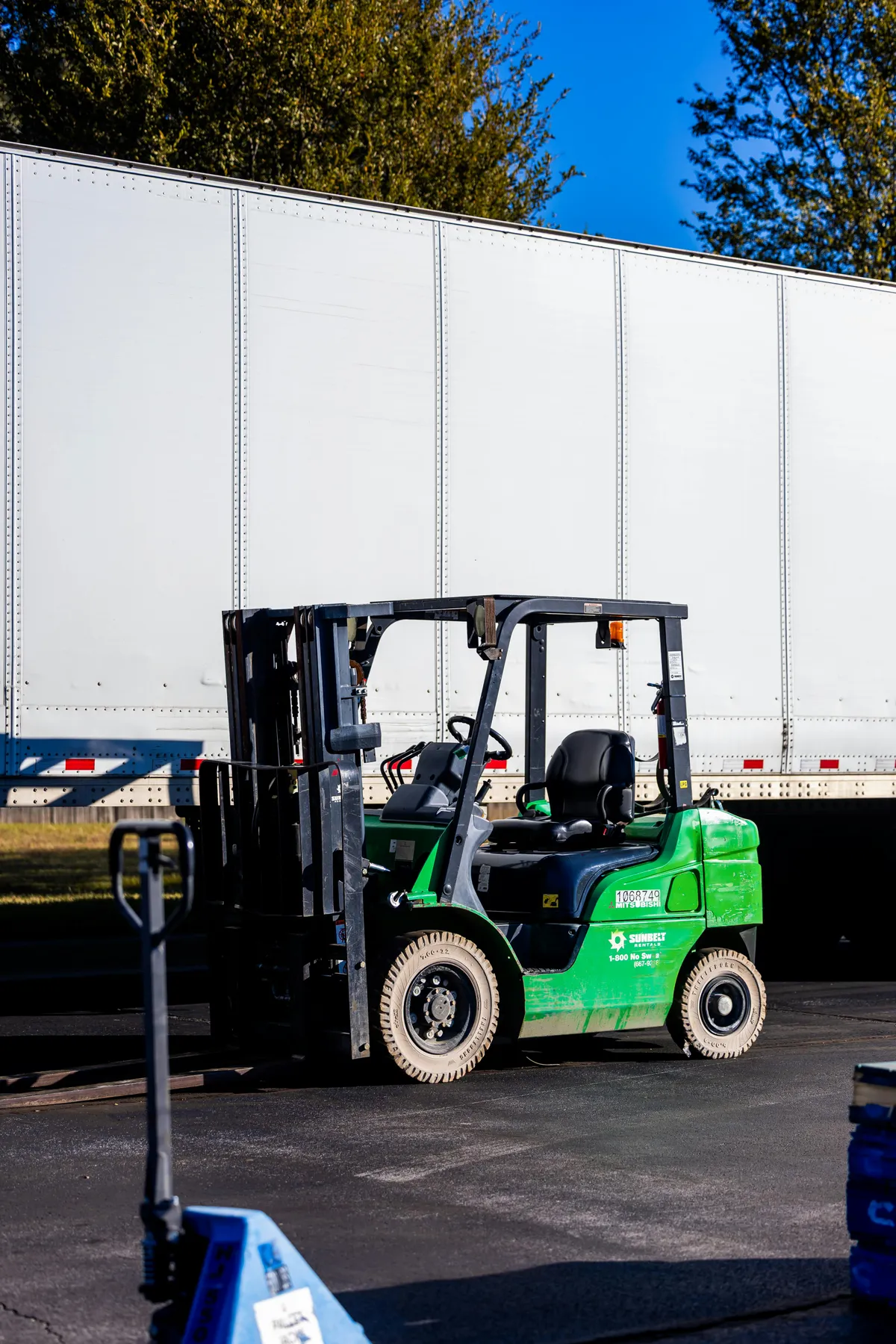
Electric forklifts reached a significant market milestone in 2024: for the first time in the US market, new electric unit shipments across Class I, II, and III exceeded internal combustion (IC) sales in total units, according to Industrial Truck Association (ITA) quarterly data. This shift reflects not just environmental pressure but a fundamental change in fleet economics. Lithium-iron phosphate (LFP) battery cell costs have dropped 60 to 70% since 2019 (BloombergNEF), closing the upfront cost gap with LPG equipment and reshaping total-cost-of-ownership calculations for operations running two or more shifts per day.
Electric Forklift Market Share: 2020 vs. 2025
| Forklift Class | 2020 Share (Electric) | 2025 Share (Electric, Est.) | Trend |
|---|---|---|---|
| Class I (electric counterbalance) | 42% of Class I/IV/V combined | 52% of Class I/IV/V combined | +10 pts |
| Class II (narrow-aisle reach/order picker) | 98% | 98% | Stable |
| Class III (walkie/rider pallet trucks) | 95% | 97% | +2 pts |
| Class V (IC pneumatic, outdoor) | IC dominant | Incremental Li-ion push | Early stage |
The outdoor Class V segment remains primarily IC-powered, but lithium-ion-equipped Class V counterbalanced units from Toyota, Hyster-Yale, and Crown are now commercially available. This signals that OEM electrification efforts are moving beyond the traditional indoor-only stronghold.
Why the Shift Is Accelerating Now
Lithium-Ion Battery Costs Have Crossed the Tipping Point
LFP battery cell prices fell from approximately $140/kWh in 2020 to under $60/kWh by early 2025 (BloombergNEF battery price survey, March 2025). For a typical Class I forklift requiring a 48V/600Ah pack, this reduction has compressed the upfront premium for lithium-ion over lead-acid from $12,000 to $25,000 to $6,000 to $14,000. Combined with the elimination of second battery banks in multi-shift operations, the payback window has dropped from 5 to 8 years to 2.5 to 4 years for most two-shift fleets.
Multi-Shift Operations: The Clearest ROI Case
Lead-acid batteries require 8 hours of charge time plus a cool-down period. A two-shift operation on lead-acid requires two complete battery banks per truck: one running, one charging. For a 20-truck fleet, that means 20 spare battery banks at $2,000 to $6,000 each, plus a dedicated battery room with ventilation, washing stations, and fire separation.
Lithium-ion eliminates this entirely. Opportunity charging between shifts and during breaks brings the pack from 20% to 80% in 1 to 2 hours without accelerating cell degradation. The capital and space savings from eliminating the battery room infrastructure often represent $80,000 to $200,000 for a medium-size fleet, and that saving appears in year one.
Regulatory Pressure Is Spreading Beyond California
California’s CARB rules are the main regulatory pressure on IC forklifts in the US, although enforcement of its Zero-Emission Forklift rule against private fleets is paused pending EPA authorization (2026 status). Beyond direct regulation, major retail and 3PL customers are increasingly embedding fleet electrification timelines into supplier ESG scorecards, creating commercial pressure that extends to operations in states with no current mandates.
Every Major OEM Has Committed
The product investment signals are unambiguous:
- Toyota launched the 8FBET lithium-ion counterbalance series, now available up to 15,500 lb, the highest-capacity electric counterbalanced forklift from a major OEM.
- Crown released the FC 5200 Series with fully integrated lithium-ion, eliminating the complexity of matching external chargers to battery packs.
- Hyster-Yale introduced the Hyster J60-100XNL lithium-ion Class V pneumatic-tire unit, the first mainstream lithium-ion outdoor capable Class V from a major US brand.
- Jungheinrich now offers lithium-ion as a standard configuration option across its full 2025 Class I to III lineup in North America.
No major OEM has announced new IC engine development programs for industrial forklifts. Capital investment has decisively shifted toward electrification.
What Operations Should Budget for in 2025 to 2026
Transitioning from LPG to electric:
| Cost Item | Range |
|---|---|
| Per-unit upfront premium (electric vs. LPG) | $4,000 to $12,000 |
| Lithium-ion vs. lead-acid premium (if choosing Li-ion) | $6,000 to $14,000 additional |
| Charging station installation | $1,500 to $8,000 per station |
| Electrical panel assessment and upgrade (if needed) | $2,000 to $15,000 (site-dependent) |
| Annual fuel savings (LPG eliminated, electricity offset) | $1,200 to $3,000 per unit |
Upgrading lead-acid electric fleet to lithium-ion:
| Cost Item | Range |
|---|---|
| Battery replacement per unit | $8,000 to $22,000 |
| Battery room decommission (HVAC, wash stations, safety) | Variable, often positive (repurpose space) |
| Reduced maintenance savings annually | $300 to $800 per unit |
| Payback period (2-shift operation) | 2.5 to 4 years |
Is Now the Right Time to Switch?
For operations currently using LPG equipment in indoor or mixed-use environments, the TCO case for electric is now positive for most single-shift and virtually all multi-shift operations. The main barrier is upfront capital, which rental and leasing structures can offset.
For operations on diesel Class V outdoor equipment, the transition is less clear-cut. Lithium-ion Class V options exist but carry cost premiums and are in early production ramp. A 2 to 3 year wait may result in meaningfully better options and lower prices for that segment.
For a side-by-side battery cost model, see our lithium-ion vs. lead-acid guide. For the current purchase vs. rent vs. lease decision on electric equipment, see the forklift cost guide and the buy vs. rent vs. lease comparison. Use the forklift selector to confirm the right class for your operation before committing to an acquisition path.
Frequently Asked Questions
Are electric forklifts becoming more common in the US?
Yes. Electric forklifts accounted for approximately 45% of all new powered industrial truck units sold in the US in 2024, up from 35% in 2020, according to Industrial Truck Association (ITA) shipment data. The growth is driven by three converging forces: lithium-ion battery cost reductions of 60 to 70% since 2019, stricter indoor air quality enforcement, and lower total cost of ownership versus LPG across most two-shift duty cycles.
Is lithium-ion replacing lead-acid batteries in forklifts?
Lithium-ion is growing rapidly in new electric forklift sales but has not yet displaced lead-acid in the installed base. As of 2025, lithium-ion represents roughly 30 to 35% of new electric forklift battery configurations in North America, up from under 5% in 2019. Adoption is highest in multi-shift operations where opportunity charging without battery swaps provides the clearest and fastest return on investment.
How much does a lithium-ion forklift battery cost in 2025?
Lithium-ion forklift battery packs (24V, 80V depending on class and model) cost $8,000 to $22,000 in 2025, down from $14,000 to $35,000 in 2020. Lead-acid equivalent packs cost $2,000 to $8,000. The payback period for lithium-ion over lead-acid depends on shift count, opportunity charging availability, and maintenance labor rates, typically 2.5 to 4 years in two-shift operations.
What do CARB regulations mean for forklift fleets in California?
Two different rules apply. CARB's In-Use Off-Road Diesel regulation covers diesel equipment, including forklifts, with its own compliance requirements. CARB's separate Zero-Emission Forklift rule targets propane and gas forklifts, but CARB is not enforcing it against private fleets until the U.S. EPA authorizes it. Check both against your fleet before you buy.
Which forklift OEMs lead in electric and lithium-ion models?
All major OEMs now offer lithium-ion electric models. Toyota launched its 8FBET lithium-ion counterbalance series up to 15,500 lb capacity. Crown released the FC 5200 Series with fully integrated lithium-ion. Hyster-Yale introduced the J60-100XNL lithium-ion Class V pneumatic-tire series, the first mainstream lithium-ion outdoor-capable unit from a major US brand. Jungheinrich offers lithium-ion as a standard configuration across most of its 2025 Class I to III lineup.