Forklift Attachments Guide: Types, Uses & Cost (2026)
Side-shifters, fork positioners, clamps, and rotators: see which forklift attachment fits your load, how much capacity you lose, and what each one costs.
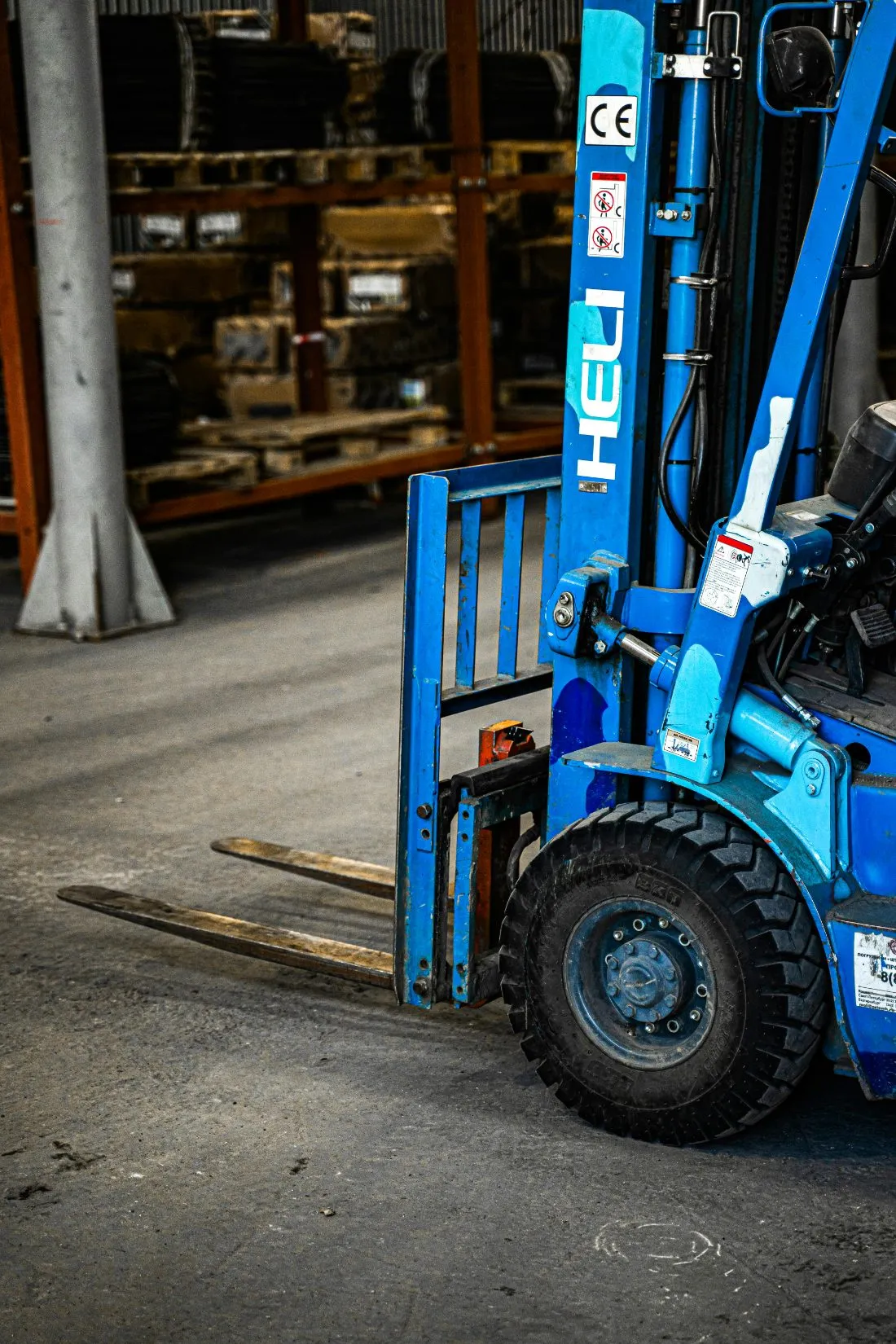
Forklift attachments are hydraulic or mechanical carriage accessories that extend a lift truck’s capabilities beyond standard pallet handling. More than 60 attachment types exist, but five categories cover 90% of industrial use: side-shifters, fork positioners, clamps, rotators, and push-pull units. Each attachment adds to the machine’s weight and shifts its center of gravity forward, which reduces the rated lifting capacity, a factor every operator and safety officer must account for before putting an equipped truck in service.
The 5 Most Common Forklift Attachment Types
Side-Shifters
A side-shifter moves the fork carriage laterally, left and right, without repositioning the truck. Operators align forks to pallet openings from the seat, eliminating the need to repeatedly reposition the forklift. Side-shifters are factory-installed on most Class I and Class V forklifts as standard equipment in North America, and industry data puts their market share at roughly a quarter to a third of all forklift attachments sold, more than any other category. Side-shifters cut pallet-alignment time by an estimated 20-30%.
Typical cost: $800-$4,000 installed, depending on class and whether it’s factory-fitted or aftermarket. Capacity reduction: 1-3%.
Best for: Loading docks, high-rack operations, any application where pallet alignment precision matters.
Fork Positioners
A fork positioner adjusts the spread between the two forks hydraulically, accommodating pallets of different widths without the operator leaving the cab. Most units adjust from 7 inches to 48 inches between fork faces. In mixed-pallet distribution centers, fork positioners reduce per-cycle time by eliminating manual fork repositioning on the ground.
Typical cost: $1,200-$4,000 installed. Capacity reduction: 3-5%.
Best for: Distribution centers handling mixed pallet sizes, grocery and food service operations.
Clamps (Carton, Paper, Barrel)
Clamp attachments replace the standard forks entirely and use hydraulic arms to squeeze loads. Variants include:
- Carton clamps for appliances, boxed goods, and beverage cases
- Paper roll clamps for newsprint and industrial paper rolls, in horizontal or vertical orientation
- Barrel/drum clamps for 55-gallon drums and food-grade containers
Clamps eliminate the need for pallets entirely on many loads, which is why they’re the fastest-growing attachment category as operations look to cut pallet costs.
Typical cost: $3,000-$18,000 depending on clamp type and jaw width. Capacity reduction: 10-20%.
Rotators
A rotator turns the load 360 degrees continuously, or to fixed stops at 90/180 degrees. Used for dumping containers, orienting coil stock, and handling waste bins. Combined rotator-clamps allow one machine to grip and invert a load in a single pass. Entry-level rotators for lighter loads start around $1,900-$3,500. High-capacity units built for heavier loads can run $6,000-$25,000 or more.
Typical cost: $4,000-$9,000 for a standard-duty unit. Capacity reduction: 8-15%.
Best for: Foundries, recycling, food processing, paper manufacturing.
Push-Pull Units
A push-pull attachment handles slip-sheeted loads, flat sheets under unit loads used instead of pallets. The attachment grips the slip sheet’s lip, pulls the load onto the carriage, and pushes it off at the destination. Common in import/export and large grocery distribution where eliminating wood pallets reduces landed cost.
Typical cost: $5,000-$11,000. Capacity reduction: 10-25%.
Best for: Import/export, food distribution, retail, any operation reducing pallet cost and stack height.
How Big Is the Forklift Attachment Market?
As with most equipment categories, analysts don’t agree on an exact figure, but the direction is consistent: steady mid-single-digit growth.
| Source | Market Size | Projection | Growth |
|---|---|---|---|
| DataIntelo (2025) | $4.8B (2025) | $8.1B by 2034 | 6.0% CAGR |
| Persistence Market Research (Dec 2025) | $5.9B (2026) | $9.0B by 2033 | 6.1% CAGR |
Both firms agree on the shape of the market even where the dollar figures differ: side-shifters lead by share (32.4% per DataIntelo, 26% per Persistence Market Research), clamps are growing fastest at roughly 6.9% CAGR, and North America alone is expanding at about 5.7% CAGR, driven by warehouse automation and ongoing labor shortages. Aftermarket attachments (bought separately from a used or existing forklift, rather than at time of purchase) make up close to 28.6% of category revenue and are growing faster than the category average, at 6.8% CAGR. Online distribution is the fastest-growing sales channel at 8.4% CAGR, as more buyers compare specs and prices before calling a dealer.
On the manufacturing side, Cascade Corporation leads the global attachment market with an estimated 22-25% share and a catalog of more than 9,000 SKUs, which is one reason its attachments show up across so many forklift brands: most manufacturers integrate a small number of dominant attachment makers rather than building their own.
Quick-Change Attachment Systems
A growing share of new attachment sales isn’t a single attachment at all, but a quick-change (quick-coupler) system that lets one forklift swap between multiple attachments in under two minutes using a hydraulic coupler instead of manually pulling and reinserting mounting pins. In practice, that means the same truck can run forks in the morning, switch to a clamp for an afternoon unloading job, and swap to a rotator for end-of-day drum handling, without a second machine on the floor.
For operations juggling several load types with a small fleet, a quick-change system is effectively a way to buy flexibility instead of buying a second or third specialized forklift. It costs more up front than a fixed attachment, but the math is straightforward: compare the incremental system cost against the return on a second unit you’d otherwise need to lease or buy.
Smart Attachments and IoT
A smaller but fast-growing slice of the market adds sensors, load-weighing, or connectivity to standard attachments so a fleet manager can track cycle counts, load weights, or maintenance intervals remotely. These “smart” attachments carry a price premium of roughly 20-40% over the equivalent mechanical version. For a single forklift, that premium is hard to justify. For a fleet running the same attachment across a dozen trucks, the utilization and maintenance data can pay for the upgrade through fewer unplanned attachment failures.
How Attachments Affect Forklift Capacity
OSHA requires that any forklift fitted with a non-factory attachment carry a revised nameplate showing the new de-rated capacity at the load center. The rule applies even if the attachment was present when the forklift was purchased used.
| Attachment | Typical Weight Added | Capacity Reduction |
|---|---|---|
| Side-shifter | 50-120 lb | 1-3% |
| Fork positioner | 80-200 lb | 2-5% |
| Carton clamp | 400-900 lb | 8-18% |
| Paper roll clamp | 800-2,000 lb | 12-22% |
| Push-pull unit | 350-700 lb | 10-20% |
A worked example makes this concrete. A 5,000 lb-rated forklift fitted with a 400 lb side-shifter has a net capacity of about 4,600 lb. The same truck with a heavier 500 lb side-shifter drops to roughly 4,500 lb. That difference between two side-shifters on the same base machine is exactly why the manufacturer’s de-rated nameplate, not the table above, is the number you sign off on before the truck goes into service. Always use the manufacturer’s de-rate tables. The figures above are approximations for planning.
New vs. Aftermarket Attachments
Not every attachment has to come from the forklift manufacturer at time of purchase. Aftermarket attachments (bought separately and fitted to a used or existing truck) already make up close to 28.6% of category revenue and are growing faster than new-equipment attachment sales. The trade-offs are straightforward:
- New/OEM attachments carry manufacturer warranty coverage and a guaranteed fit, but cost more and may require ordering lead time.
- Aftermarket attachments are typically cheaper and available faster through independent suppliers, but you need to verify hydraulic compatibility and get the de-rated nameplate from whoever supplies the attachment, not just the original truck manufacturer.
Either way, the de-rated nameplate requirement applies regardless of who made the attachment. OSHA doesn’t distinguish between OEM and aftermarket for compliance purposes.
Renting a Forklift With an Attachment
If you only need an attachment for a short job, buying one outright rarely makes sense. Some rental dealers stock forklifts with common attachments (side-shifters especially, since they’re standard on many units already) or offer clamps and rotators as an add-on for an extra monthly fee, typically in the same range as the aftermarket purchase prices above spread across the term. Confirm the attachment is on the written rental agreement, not a verbal add-on, since the de-rated capacity and any attachment-specific damage terms need to be documented the same way the base unit’s specs are.
What to Check Before Buying an Attachment
Before specifying an attachment:
- Confirm carriage class. Class II (24-inch), Class III (30-inch), and Class IV/V (33-60-inch) carriages require different mounting brackets.
- Verify hydraulic flow requirements. High-flow attachments need a forklift equipped with auxiliary hydraulics. Confirm the truck’s flow rate matches the attachment spec.
- Get the de-rated nameplate. The attachment manufacturer must provide this with every attachment sold. OSHA requires it to be installed before the truck re-enters service.
- Check load center impact. An extended attachment moves the load further from the mast and compounds the capacity reduction beyond the nameplate adjustment.
- Weigh quick-change against dedicated mounts. If you’re running more than two attachment types on the same truck regularly, a quick-change coupler usually pays for itself faster than swapping pins by hand.
For guidance on which forklift class supports the attachments your operation needs, use the forklift selector or review our forklift classes guide. If you’re weighing electric vs. IC for an attachment-heavy application, our electric vs. LPG comparison covers the hydraulic output differences between fuel types. And if you’re trying to decide whether a new attachment or a second forklift makes more financial sense, run the numbers through our forklift ROI guide first.
Sources
- Conger Industries, “Types of Forklift Attachments Guide” (https://www.conger.com/types-of-forklift-attachments-guide/)
- My Little Salesman, “Forklift Attachments Guide: Types, Functions & Safety Considerations” (https://www.mylittlesalesman.com/news/forklift-attachments-buying-guide)
- DataIntelo, “Forklift Attachment Market Report” (https://dataintelo.com/report/forklift-attachment-market)
- Persistence Market Research, “Forklift Attachments Market” (https://www.persistencemarketresearch.com/market-research/forklift-attachments-market.asp)
Frequently Asked Questions
Does adding a forklift attachment reduce lifting capacity?
Yes. Every attachment adds weight to the carriage, which shifts the center of gravity forward and reduces the forklift's rated capacity. The attachment manufacturer supplies a de-rated nameplate. OSHA requires this updated plate to be installed on the truck. Capacity reductions typically range from 5% to 25% depending on attachment weight and configuration.
What is a side-shifter on a forklift?
A side-shifter is a hydraulic carriage attachment that moves the forks laterally, left and right, without repositioning the truck. It lets operators align forks with pallet openings from the seat, cutting cycle time 20-30% in busy loading dock and racking environments. Side-shifters are factory-installed as standard equipment on most Class I and Class V forklifts sold in North America.
What is the most common forklift attachment?
The side-shifter is the most widely fitted forklift attachment, holding roughly a quarter to a third of the global attachment market by unit share and installed as standard equipment on most new Class I and Class V forklifts. Fork positioners are the second most common, especially in operations handling pallets of varying widths.
Can you put attachments on a rented forklift?
Some rental companies offer attachments as add-ons, but availability varies by market and dealer. Confirm with the rental company before booking. Installing non-approved attachments on a rental unit typically violates the rental agreement and shifts liability to the renter.
How big is the forklift attachment market?
Estimates put it between $4.8 billion and $5.9 billion as of 2025-2026, growing at roughly 6% a year through the early 2030s. Side-shifters are the single largest category by share, and clamps are the fastest-growing segment as more operations move away from pallets entirely.
What is a quick-change forklift attachment system?
A quick-change (or quick-coupler) system lets one forklift swap between attachments, such as forks, a clamp, and a rotator, in under two minutes using a hydraulic coupler instead of manual pin removal. It turns one truck into a modular toolkit that can replace several single-purpose machines on a busy floor.